

Hello. The column “Sake Talk” has now entered its sixth year! We hope you will continue to enjoy our article. In this time, we introduce about the former Hakushika-kan, a facility built by Tatsuma-Honke Brewing Co., Ltd. in 1930 that combined the functions of a brewing plant with refrigeration equipment and a bottling plant.
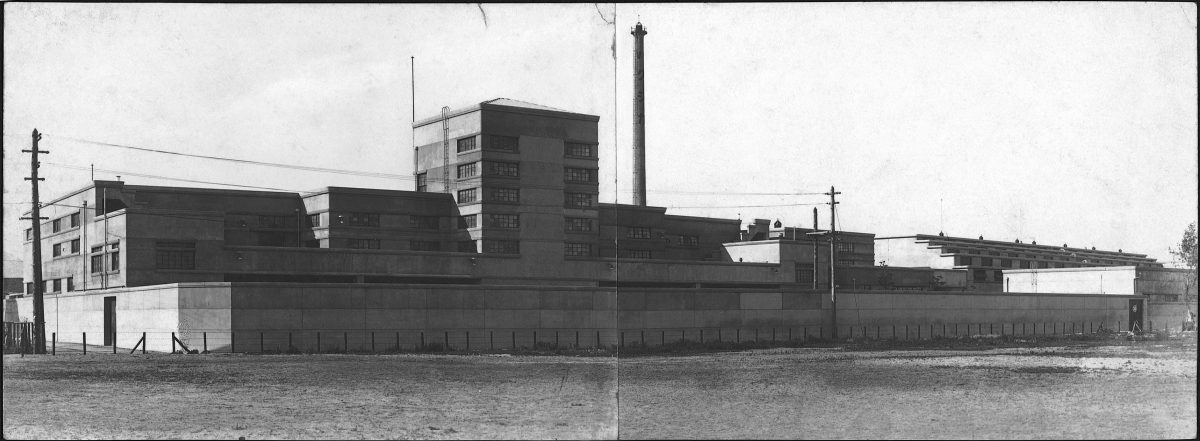
Since the modern era, Tatsuma-Honke Brewing Co., Ltd. had been built many wooden breweries mainly in Nishinomiya, and gradually increased its production of sake. Furthermore, starting around 1907, bottled sake production gradually began in the Nada region. As demand grew significantly into the Showa period (1926-1989), it became necessary to construct modern, fully equipped brewing and bottling factories. Therefore, construction of the Hakushika-kan began by Takenaka Corporation on June 16, 1929.
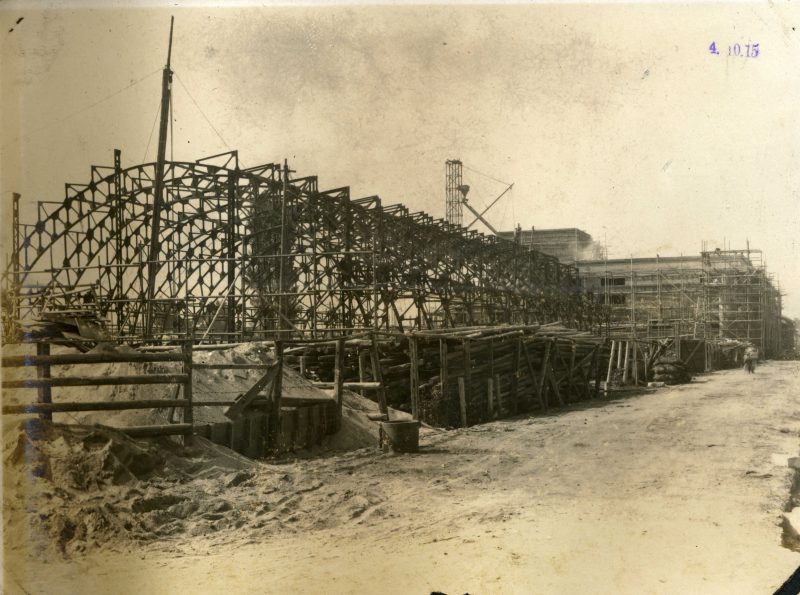
The arched steel structure in the foreground is the bottling plant; the brewing plant is in the background.
The Great Kanto Earthquake, which occurred September 1, 1923, also had a significant impact on sake brewing industry. So, reinforced concrete sake breweries could be constructed. The pioneer was Gekkeikan Co., Ltd., in Fushimi, Kyoto Prefecture, which built Japan’s first reinforced concrete brewery in 1927. Through this trend, Tatsuuma-Honke Brewing Co. Ltd., was started to build concrete sake brewery, Hakushika-kan.
In November 1929, the brewing plant was completed, followed by the bottling plant in May 1930. The brewery’s defining feature was its refrigeration equipment. This allowed the plant to make “chilled nama-zake (non-pasteurized sake)” and its sale began around 1935. However, at the time, home refrigerators were not yet commonplace, making preservation difficult, so sales volumes could not be increased.
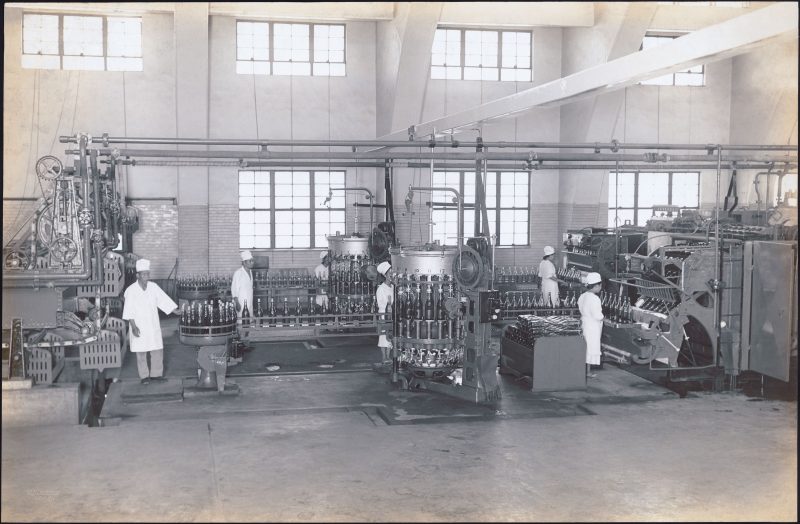
The bottling line was installed in ample space created by the arch structure.
On the other hand, the bottling plant’s defining feature was its architecture. The bottling line at that time was linear, requiring a vast space with few pillars. However, when considering earthquake resistance in preparation for disasters like the Great Kanto Earthquake, pillars become necessary. This problem was overcome by the design from Takenaka Corporation. At the bottling plant of the Hakushika-kan, the arched roof design successfully maintains seismic strength while providing ample space.

The completed Hakushika-kan operations as a cutting-edge sake brewery and was also showcased during tours hosted by Tatsuuma-Honke Brewing for its authorized dealers. Despite being directly hit by incendiary bombs during the WWII, it miraculously escaped fire damage. After the war, it continued operating as the main facility of Tatsuuma-Honke Brewing and was cherished by many as a renowned architectural landmark. However, it ceased operations because of deterioration in July 2010 and was dismantled in 2011. In the Sakagura-kan of the Sake Museum, models and parts of steel structures of the Hakushika-kan are displayed, so please visit to feel an old great architecture. In the next article, we will introduce about the Shinden-gura, a large wooden sake brewery in the Meiji period (1868-1912). We look forward to seeing you again next month!
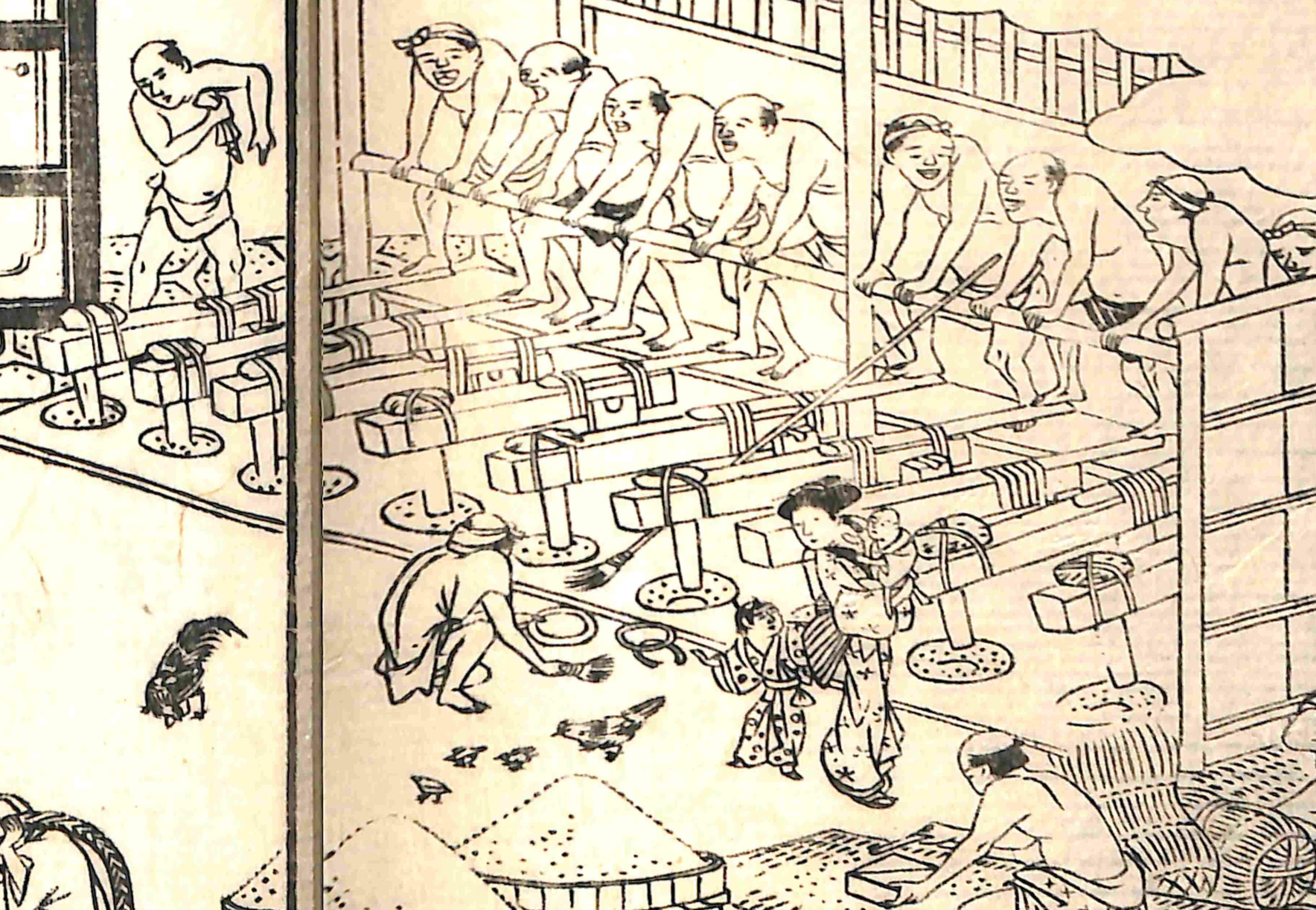



Well-polished white rice is needed for sake brewing!